What is Mystery?
Is it worth it to study God?

After one attempt at publishing this essay and embarrassingly realizing (24 hours later) that I had somehow posted my draft, here is the actual essay. Cheers to being human :)
Pop culture loves mystery. It comes in two main types.
First, there are the solvable ones. Think of Knives Out or Sherlock Holmes. We, as the audience, enjoy the delectable tension of not knowing who might have committed the crime. We delight in the tension of piecing together the entire puzzle bit by bit, clue by clue, fingerprint by fingerprint. We love watching the characters slowly put it together, all for that ecstatic “Aha!” moment when we feel like we solved the puzzle, even though it’s really the characters doing all the work.
Second, there are the unsolvable ones. The cold cases. There are no answers, but that’s sometimes even more exciting than the ones that do give us the answers. Instead of a laid-out narrative from start to end, we can interpret the facts for ourselves, to try to piece together the puzzle for ourselves. At the end of the day, we know that we can’t gather the answer, so we’re left in a suspenseful tension, wondering whether or not the truth might ever come out.
But…when it comes to God, we reach a problem. God doesn’t quite fit into either type of mystery. We can’t say “Aha! We have solved God! We know who He is, and what He has come to do, and His plans!” That doesn’t work logically; we have finite minds and finite knowledge, thus we cannot fully know infinite things, like God. On the other hand, we can’t say “Well, we’re not quite sure what happened, just that these events occurred in and near Jerusalem in about 33 A.D., and we’ve pieced together the rest.” God taught us, through Himself in Christ, exactly what He came here to do, what His plan was, and where He was going. So in that aspect, it’s not quite an unsolved mystery either. In fact, Christ quite plainly says,
“The secret of the kingdom of God has been given to you.” (Mk 4:11)
Someone might say, “Well, maybe we shouldn’t look at God as a mystery; perhaps that’s the wrong word.” If so, then they have a much bigger problem to reckon with: Christ Himself uses the word mystery. In that line from Mark 4 that I just quoted, the word “secret” is translated from the Greek word musterion, meaning “mystery.” Not only that, we use the term mystery for a whole genus of teachings in the Church. Every time we go to Mass (in the Roman Rite), we proclaim the Mysterium Fidei, the Mystery of Faith: “When we eat this bread, and drink this cup, O Lord, we profess your Resurrection, until you come again.” The Eucharist in itself is a mystery according to the Church; we talk about the “Paschal Mystery” every Easter. And, most famously (or perhaps infamously if you’ve ever sat through a lecture on it), is the mystery of the Holy Trinity. So, what kind of mystery pertains to God?
Now, you might say, “What does any of this matter?” Well, I think it matters quite a lot. See, if you take the Trinity, the Eucharist, or the Paschal Mystery to be an “unsolvable” kind of mystery, a “cold case” if you will, you will very quickly find people tempted to (as many already do today) resign themselves to knowing nothing about it. Someone might say, “If it’s a mystery that we cannot solve, there’s no point in troubling myself needlessly over something I’ll never know.” This is a tragedy. Every day, on our phones, we encounter dozens, if not hundreds, of various ideologies, opinions, statements, claims, and postulations from people throughout the world, all seemingly having educated reasons for these opinions and postulations. How foolish do we make the Church, and ourselves, look if our answer to these claims of the world is simply, “I don’t know, and it’s not something we can know.”
Our Lord prayed at His Last Supper that the Father would ‘sanctify them in the Truth; Your Word is Truth” (John 17:17). By all accounts, Christ seems to want us to work out the Truth for ourselves, not simply throw our hands up in the air and walk away from learning about Him. He was called “Rabbi” after all; He teaches us rationally, with an end in mind, “that they may know you, the only true God, and Jesus Christ whom you have sent” (Jn 17:3). Taking Christ at His word (which is generally a good practice), He seems to command that we can, and must, come to know Him, regardless of the mystery of it all.
We now reach a crossroads with our current definitions of mystery: either, on the one hand, God is not a good God. What kind of God who proclaims His goodness and love would order His followers to try and follow a command that they simply couldn’t? On the other hand, like we said earlier, God cannot be God if we can truly know and comprehend Him entirely, as that would contradict the laws of logic. It’s safe to assume here that there must be something that we’re missing.
What if there was a third kind of mystery? One that we could comprehend and know at one level, and yet be drawn ever deeper into the depths of it that we cannot comprehend? If that doesn’t make sense, that’s ok, it will in a moment. There’s a common area of life that we can use as a reference to understand this third type of mystery: that common area being art.
Consider looking at this icon, Rublev’s The Trinity, written in 1425.
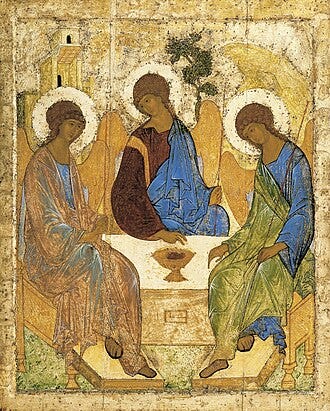
At first glance, we see the three angelic figures around the table. Looking again, and a little deeper, more details start to show up. They all look the same, but are dressed differently. There’s a tree in the background, and a house of some sort. The middle figure and the figure on the right are bowing their heads towards the one on the left. Then you might remember that this icon is commonly called The Trinity, and consider the relevance of that to the piece. A glance deeper again, and you realize that maybe that’s why all the faces are the same, suggesting one nature, but all the garments are different, suggesting three distinct Persons.
Suppose you went to a recital of Bach’s Well-Tempered Clavier. On first hearing, you may be moved by the various melodies up and down the piano. The second hearing, you may realize that it’s alternating through all the major and minor keys of music, giving you a full appreciation of how the piano might be played as few other pieces can. The third time, you may appreciate the varying movements through the preludes to each key and the fugues, noticing the various rhythms that Bach uses to communicate an almost entirely different sentiment through each section. And so on.
The same is true, analogously, of the mysteries of God. We are called to know Him; He desires for us to learn about Him, to set our minds upon Him in an ever greater desire for understanding of His ways and Himself. And yet, we will never come to fully know Him, as He is Eternal. He is Knowledge and Truth itself. Every time we consider that we know that Christ died for our sins on the cross, we might stop and consider how much we don’t know that He died for our sins on the cross. Each time we consider it, we are called to consider it on a deeper level. There will never be a point in our lives, either here or in Heaven, where we can lean back in our metaphorical chairs and say, “That’s it: I understand the Paschal Mystery.” This is a “great mystery,” (Ephesians 5:32) St. Paul says. This mystery, the mystery of God, will enwrap our entire existence in the life to come. Whatever we can learn of Him here is absolutely necessary, though: we will need it to know Him on the Other Side.
Above all, here in this life, this third type of mystery, the mystery of Truth, Goodness, and Beauty, the mystery of God Himself, is the most satisfying kind of mystery. In this mystery, we are faced with facts that we can never fully solve or comprehend; the tension never unwinds, and there’s always another piece to the story. But, piece by piece, the mystery gets ever more lovely, joyful, hopeful, and Good, the closer that we get to Him. Why would you not want to learn more about that mystery?